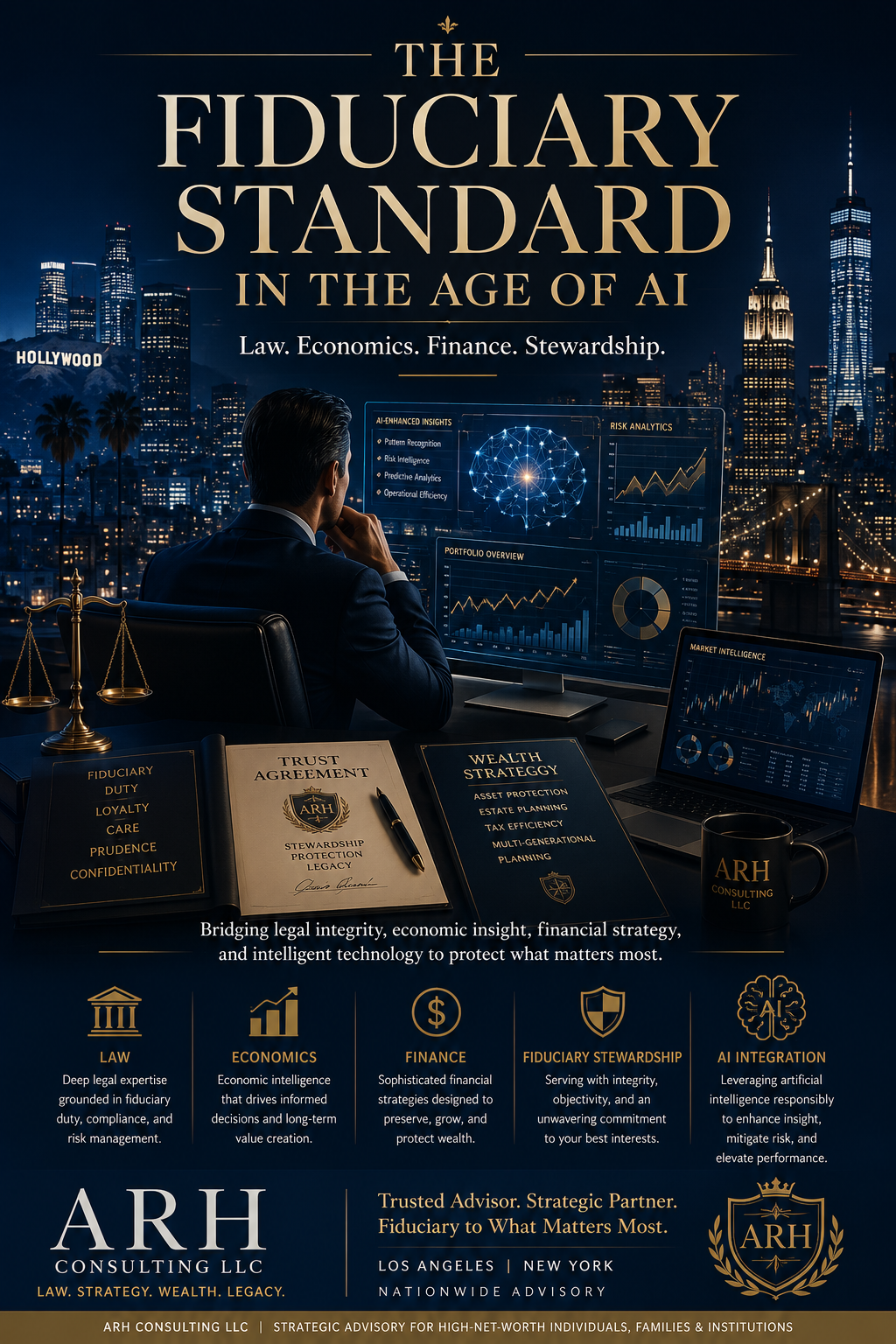
Why the Future of Wealth, Law, and Financial Stewardship Will Belong to Professionals Who Understand All Three
By Alejandro Hernandez, J.D.
ARH Consulting LLC
Los Angeles | New York
Artificial Intelligence is rapidly transforming the fiduciary landscape, but the conversation surrounding AI often misses one critical reality: fiduciary management is not simply a technological function. It is a legal, economic, and financial responsibility rooted in trust, judgment, and accountability.
For decades, fiduciary professionals have operated at the intersection of law, finance, risk management, and human behavior. Whether serving as trustees, advisors, wealth managers, estate fiduciaries, corporate officers, or strategic consultants, fiduciaries are ultimately responsible for protecting the interests of others while navigating increasingly complex financial and regulatory environments.
Artificial Intelligence is now entering that equation in a profound way.
The firms and professionals that understand how to integrate AI into fiduciary operations without compromising ethical standards, legal responsibilities, or financial stewardship will shape the future of the industry. Those who fail to understand the broader implications of AI may discover that technology can create as much exposure as opportunity.
The fiduciary profession has always depended on informed decision-making. Every major fiduciary action involves some combination of legal interpretation, economic analysis, financial judgment, and operational execution. AI has the potential to strengthen all four areas simultaneously. At the same time, it also introduces entirely new categories of risk that many organizations remain unprepared to address.
From a legal perspective, fiduciary duties remain unchanged regardless of technological advancement. Duties of care, loyalty, confidentiality, disclosure, prudence, and oversight continue to govern fiduciary conduct. AI does not eliminate liability. In many ways, it may increase expectations surrounding competence and operational governance. If a fiduciary organization adopts AI systems without proper oversight, documentation, compliance safeguards, or review procedures, the consequences could become substantial.
This is where many conversations about AI become dangerously oversimplified. Technology vendors frequently market AI as an efficiency solution, but fiduciary environments cannot operate solely on efficiency. Fiduciary management requires defensible judgment, transparency, and accountability. Every recommendation, workflow, communication, and financial decision may ultimately be scrutinized through legal, regulatory, or financial lenses.
That reality changes the AI conversation entirely.
Economic pressures are also accelerating AI adoption across fiduciary industries. Rising operational costs, increased compliance burdens, staffing challenges, cybersecurity threats, and heightened client expectations are forcing firms to modernize. Organizations that continue relying entirely on legacy systems may struggle to remain competitive in an increasingly data-driven environment.
AI is helping address these pressures by streamlining administrative operations, enhancing document analysis, improving compliance monitoring, organizing financial information, and assisting with predictive risk analysis. What previously required substantial manpower can now often be completed with significantly greater speed and operational consistency.
However, the true value of AI is not simply operational reduction. It is strategic intelligence.
The fiduciary firms gaining the greatest advantage are not merely automating tasks. They are using AI to improve decision-support systems, identify patterns earlier, reduce informational blind spots, and create more responsive operational infrastructures. In high-value wealth management and fiduciary environments, this shift may become one of the defining competitive differentiators of the next decade.
Financial stewardship itself is evolving alongside these technologies. Modern fiduciary management increasingly requires the ability to interpret large amounts of financial data while maintaining a sophisticated understanding of economic conditions, market volatility, asset protection considerations, and long-term strategic planning. AI systems can assist in organizing and evaluating data, but they cannot replace seasoned judgment regarding risk tolerance, family dynamics, economic uncertainty, or fiduciary discretion.
This distinction is critical.
Artificial Intelligence may enhance analysis, but it does not possess fiduciary wisdom. It cannot replicate human trust, ethical reasoning, emotional intelligence, or strategic judgment developed through years of legal, financial, and operational experience. The professionals who thrive in this next era will not be those who blindly rely on automation. They will be those who understand where technology ends and fiduciary responsibility begins.
Another major issue emerging within fiduciary management is AI governance. Many organizations are implementing AI tools faster than they are creating policies governing their use. This creates substantial exposure. Questions surrounding data privacy, cybersecurity, misinformation, algorithmic bias, documentation retention, and human oversight are becoming increasingly important across financial and fiduciary industries.
In many respects, AI governance may become the next major compliance frontier.
Forward-thinking organizations are already developing internal frameworks governing how AI systems are used, what level of review is required, how outputs are documented, and how fiduciary obligations are preserved within automated environments. Firms that fail to establish these controls may eventually face regulatory scrutiny, operational failures, or reputational damage.
The future fiduciary professional will likely need a far broader knowledge base than ever before. Understanding law alone will not be enough. Understanding finance alone will not be enough. Understanding technology alone will not be enough. The modern fiduciary environment increasingly requires professionals who can operate across legal reasoning, economic analysis, financial strategy, operational systems, and technological governance simultaneously.
This convergence is already occurring across wealth management, estate administration, trust services, business advisory, compliance consulting, and professional services industries nationwide.
The organizations that recognize this shift early will possess a significant advantage.
Artificial Intelligence is not replacing fiduciary professionals. It is reshaping the standard of competence expected from them.
The future of fiduciary management will belong to professionals who understand how to combine legal insight, economic strategy, financial stewardship, and technological intelligence into a cohesive operational model capable of serving clients responsibly in an increasingly complex world.
That future is already beginning.
About the Author
Alejandro Hernandez, J.D. is the founder of ARH Consulting LLC, a strategic advisory firm focused on AI integration, operational consulting, fiduciary strategy, legal-tech modernization, and business development for professional service organizations, law firms, and growth-oriented enterprises.
Los Angeles | New York
http://www.arhconsulting.com
#ArtificialIntelligence #FiduciaryManagement #WealthManagement #LegalTech #AICompliance #FinancialServices #Economics #BusinessStrategy #TrustAdministration #AIinFinance
